
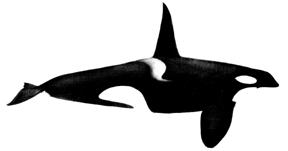
 External Anatomy
Very tall, straight characteristic dorsal fin up to 6 ft. (1.8 m) in males
Jet black and pure white coloration
White patch behind each eye
Gray saddle patch behind dorsal fin
White chin, chest and sides
Large, paddle-shaped flippers
Robust, heavy, stocky body
Rounded head tapers to a point
Indistinct beak
Average adult body length: 6.7-8 m (males) 5.7-6.6 m (females)
Average body weight: 4-6.3 tons (males) 2.6-3.8 tons (females)
Swimming Adaptations
Geographical Distribution:
Widely distributed in all oceans and most seas, from the coast to the very deepest waters
Patchy distribution
Able to live, reproduce and feed throughout the year in either warm or cool waters
No regular patterns of migration
Movements occur due to ice cover in high latitudes and food availability elsewhere
Natural History:
HABITAT:
Adaptable to almost any conditions
Generally prefers deep water but is found in shallow bays, inland seas, and estuaries
FOOD & FEEDING:
One of the most varried diets of all cetateans
Prey include at least 24 species of cetaceans, five species of pinniped, dugong, 30 species of fish, seven species of
bird and two specoes of squid, inaddition to a variety of other warm-blooded and cold-blooded sea creatures, such as
turtles
Feeding dives to depths of less than 100m
Pods cooperate during a hunt
Pods tend to specialize and frequently ignore potential prey
LIFE CYCLE:
Reproductive characteristics have not been firmly established
Gestation lasts at least a year, perhaps several months longer
Calves born in fall and winter
Calves dependent for more than a year
Calving interval averages more than 2 years
BEHAVIOR:
Breaching, lobtailing, flipper-slapping and spyhopping common
Other behavior includes beach-rubbing, speed-swimming, logging and dorsal fin slapping
Can travel at up to 34 mph (55 km/h)
Travel in pods of 3-25 whales
Two or more pods may come together to form superpods of 150 or more whales
Members of pod stay together for life
Groups of closely related pods (known as clans) develop their own unique dialects
Highly inquisitive and approachable
WORLD POPULATION:
Total world population unknown
350 in Vancouver Island, Canada and Washington State
6618 in Iceland and Faeroese
289 in Shekilof Strait, Prince William Sound and southeastern Alaska
total of 324 individuals in Alaska
HUMAN INFLUENCES:
Captured by commercial whalers on regular basis
No fishery aimed at killer whalers has developed
Subjected to control measures because of their extensive diets

 Bald Eagles The bald eagle (Haliaeetus
leucocephalus), our national bird, is
the only eagle unique to North
America. The bald eagle's scientific
name signifies a sea (halo) eagle
(aeetos) with a white (leukos) head.
At one time, the word "bald" meant
"white," not hairless. The bald eagle
is found over most of North American,
from Alaska and Canada to northern
Mexico. There are an estimated
50,000 bald eagles in the United
States, with 80 percent of them
found in Alaska.
The U.S. Fish and Wildlife Service
is proposing that the bald eagle be
declared fully recovered, with final
action due in July 2000. Even if the
U.S. Fish and Wildlife Service
removes the bald eagle from the
threatened and endangered species list, it will still be protected by the Migratory Bird Treaty Act and the Bald
and Golden Eagle Protection Act.
Not all eagles migrate. Those that do, have complex migratory patterns. While migrating, eagles ride
columns of rising air called thermals and can average speeds of 30 mph (50 kilometers). Effortlessly, an eagle
can circle in a strong thermal to high altitudes, then glide long distances in the direction of its migration until it
finds the next column of rising air. Generally, the eagles follow seasonal food supplies. As lakes and streams
freeze over, bald eagles must go south to find open fresh water or head to the coast.
